


Managing factory overheads in Sri Lanka has become an exercise in volatility.
Every time the Ceylon Electricity Board (CEB) announces a dynamic tariff revision, the cost of running a production line shifts. For large-scale manufacturing facilities, food processing plants, and garment exporters, electricity isn’t just a utility bill anymore.
It is a massive, unpredictable line-item expense. And it directly impacts your competitive edge in local and global markets.
If your factory relies on heavy machinery, cold storage, or multiple shifts, you’ve almost certainly looked at your roof space. You have likely considered an industrial solar power plant.
But you need real figures, not marketing fluff. How much can you actually save?
What does a commercial solar panel for factory installation look like on the balance sheet? Let’s break down the economics of industrial rooftop solar in the current market, focusing strictly on ROI, system viability, and operational security.
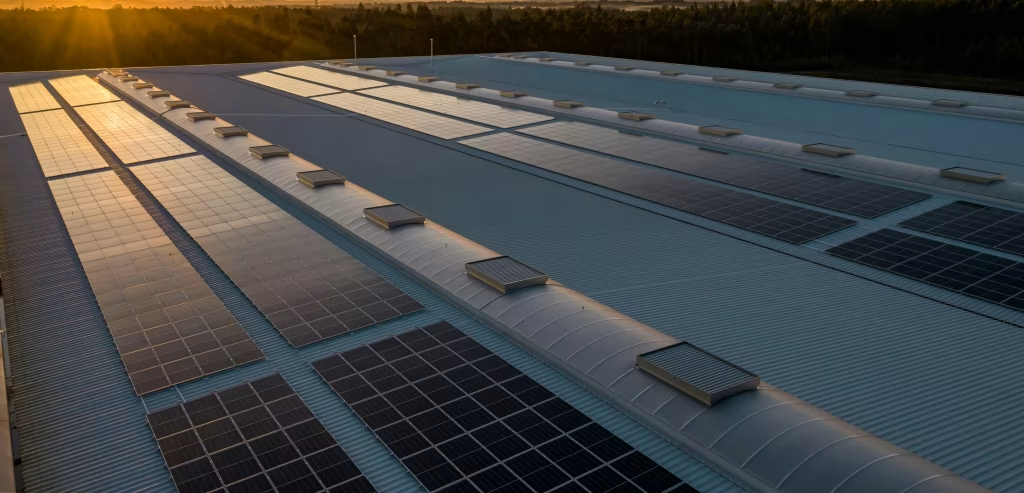
Industrial Solar Power Plant Savings vs. Rising Electricity Tariffs
To understand the scale of your potential savings, you have to look at what you are currently paying per kilowatt-hour (kWh).
Large-scale industries operating under high-consumption bulk supply tariffs face heavy demand charges alongside regular usage fees. When you factor in daytime production hours, the math becomes very simple.
You are buying power at its peak cost while your factory roof sits under some of the highest solar irradiance in South Asia.
When you install a dedicated solar panel for factory use, you essentially transition from buying volatile grid energy to producing fixed-cost power.
The immediate financial impact depends on your factory’s energy consumption profile. However, for a standard medium-to-large facility, the metrics are remarkably consistent:
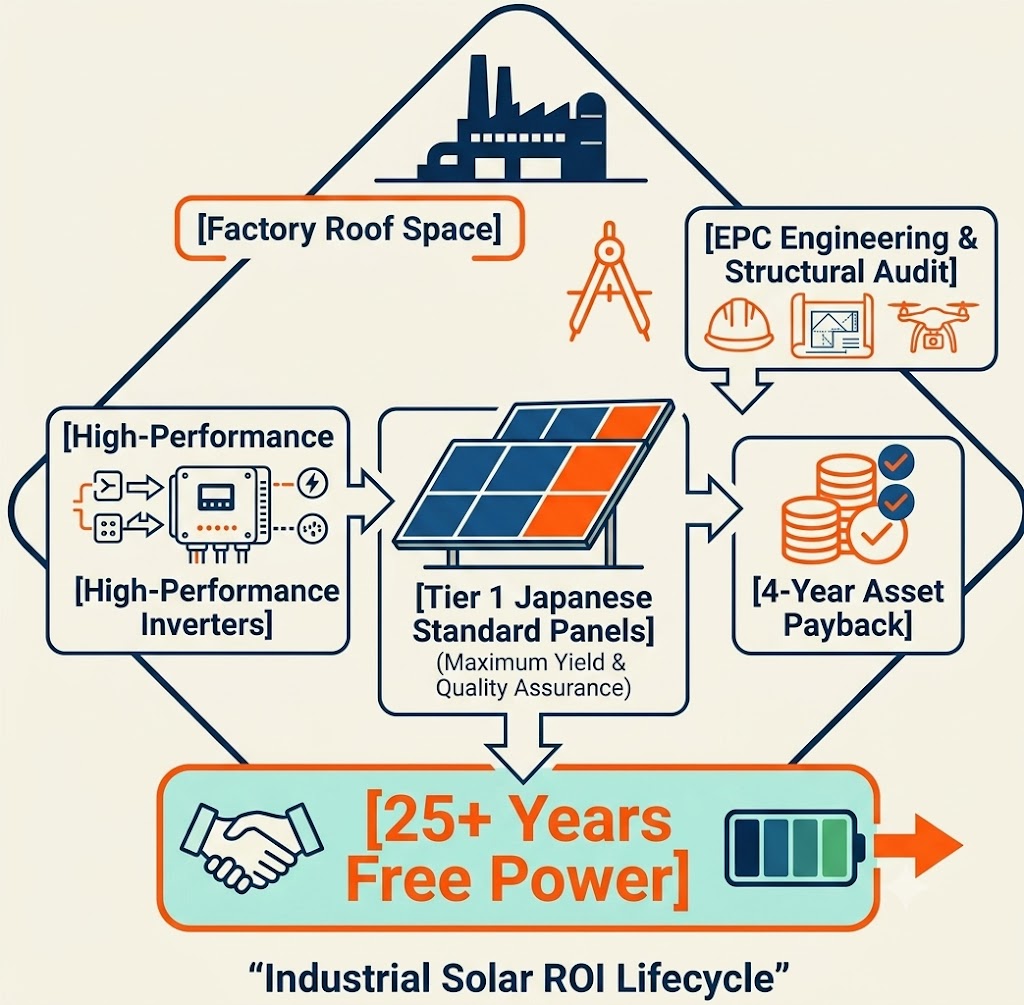
- Immediate Bill Reduction: A properly designed system can offset 60% to 85% of your daytime operational energy costs.
- The Payback Period: For industrial installations in Sri Lanka, the return on investment (ROI) usually lands under 4 years.
- The Asset Lifecycle: A high-quality industrial system generates reliable power for 25 to 30 years.
Think about what that means for your cash flow. After year four, the electricity powering your manufacturing machinery is practically free.
In an economy where raw material costs and freight rates fluctuate constantly, locking in your energy costs for the next two decades provides an immense operational advantage. It gives you a predictability that your competitors simply won’t have.
What Determines Your Industrial Solar Power Plant Cost?
When assessing an industrial solar panel price, looking only at the initial quote can be a misleading metric.
The total cost depends heavily on structural engineering, inverter matching, and grid connection compliance.
Cheap components drive down the upfront price tag, but they destroy your long-term savings.
If an uncertified panel drops its efficiency by 15% after a few years in harsh coastal weather or high-heat industrial zones, your projected savings evaporate.
For heavy industrial use, system architecture requires components that handle consistent, high-amp loads without breaking a sweat.
The best solar panel for factory setups is always a Tier 1 certified module.
Tier 1 isn’t a brand name. It’s a strict international standard of manufacturing reliability and financial stability.
Using Japanese-engineered Tier 1 panels ensures that the silicon wafer degrades at an incredibly slow, predictable rate.
When you couple these high-grade modules with industrial-strength inverters, like Growatt, the system handles voltage spikes and complex factory loads effortlessly.
Reducing the Risks of Investing in a Solar Panel for Industrial Use
For a business, investing in a solar panel system isn’t just about environmental sustainability.
It’s an infrastructure project. That means you have to account for risk.
Factory owners routinely ask the same critical questions: What if the system doesn’t generate what was promised? What happens if there is a technical failure or a fire?
These are legitimate concerns.
If a component fails on a residential roof, a household loses a bit of credit. If a system fails on a manufacturing plant, it can disrupt production schedules and cost millions.
This is why generic, uncertified components flooding the local market are a major liability for businesses investing in solar power Sri Lanka.
To secure your investment, your project needs structural and financial safeguards built directly into the contract:
- Generation Assurances: Your solar partner should confidently guarantee exactly how many units of electricity your system will produce annually, eliminating guesswork from your balance sheet.
- Comprehensive Insurance: Industrial installations must be backed by comprehensive product liability from day one.
- Turnkey EPC Capability: The engineering, procurement, and construction (EPC) process shouldn’t be fragmented. The team designing the array must be the same team navigating the CEB regulations, testing grid synchronization, and maintaining the system.
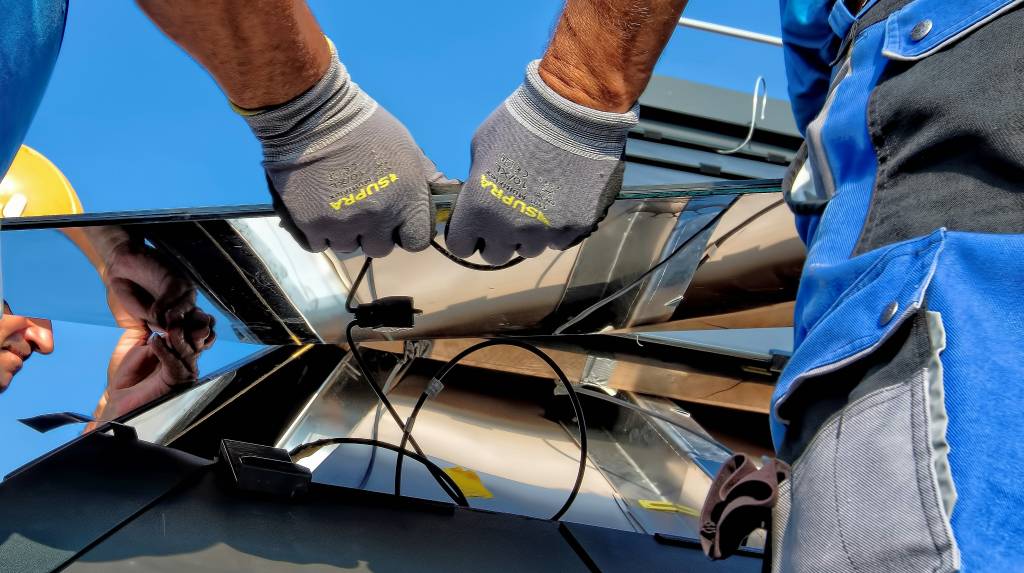
How an Industrial Solar Power Plant Secures Long-Term Energy Independence
The industrial landscape is shifting rapidly.
Relying entirely on a volatile national grid exposes your business to structural vulnerabilities that can erode your margins overnight.
Investing in high-performance Sri Lanka solar panels isn’t an experimental upgrade—it is a proven method to shield your operational budget from future tariff hikes.
At Sakura Power Solutions, we treat solar as a core financial investment for your business.
We don’t deal in generic templates or uncertified components.
As the exclusive distributor of Tier 1 Leapton Solar panels from Japan, we bring engineering precision and global standards directly to your factory floor.
With over 10 megawatts of solar capacity successfully installed across Sri Lanka—including massive 2MW, 1.2MW, and 750kW industrial plants—our team manages the entire EPC pipeline in-house.
We remove the risk from your transition to clean energy by providing full insurance, comprehensive product liability, and a firm generation assurance that guarantees your system performs exactly as promised.
If you are ready to take control of your manufacturing overheads and map out an exact ROI strategy for your facility, explore our dedicated engineering capabilities for Industrial & Commercial Projects.
If you are looking to secure your other properties, feel free to browse our specialized Residential Projects or review our technical component standards via our Products Page. Let’s build a reliable, high-yield power source that protects your bottom line for decades.